Risk-based inspection sounds simple in theory. In practice, most programs struggle with the same handful of issues, whether that’s misunderstanding what RBI actually replaces, losing momentum after the initial study, or applying the wrong technique to the wrong damage mechanism.
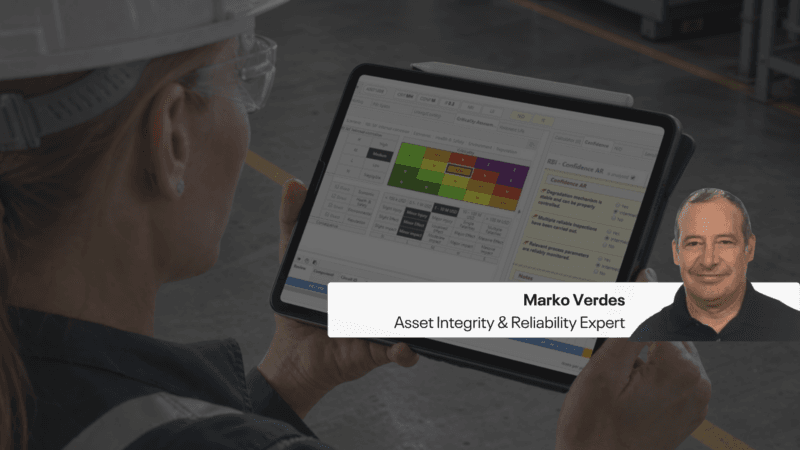
The insights below come from a recent Cenosco webinar, Modern Risk-Based Inspection (RBI) in Practice, featuring Marko Verdes, Asset Integrity and Reliability Management Expert, and Gustavo Caballeros, Partner Manager. Drawing on real implementation experience in the field, they walked through what separates RBI programs that keep working from the ones that quietly turn into a document nobody updates. Here is what they covered.
1. RBI doesn’t mean inspecting less. It means inspecting smarter.
This is the most common misconception, and it stalls more RBI programs than anything else.
RBI doesn’t mean skipping inspections or reducing safety coverage. It means directing inspection effort toward the equipment that actually carries risk, while reducing unnecessary inspections where risk is demonstrably low.
- High-risk assets get inspected more frequently
- Low-risk assets get inspected less frequently
- The net result is a safer facility, not a less-inspected one
2. Time-based schedules are a blunt instrument — and an expensive one.
Fixed intervals (e.g., 4 years, 10 years, as defined by code) treat every asset the same regardless of actual condition, operating history, or damage mechanism. This is exactly what risk-based inspection (RBI) is designed to replace: moving from time-based schedules to risk-informed intervals based on how and why equipment is likely to fail. The result:
- You over-inspect equipment that doesn’t need it
- You potentially miss developing damage in equipment that does
One Cenosco case study: a storage tank on a 10-year time-based cycle was extended to 17 years following a risk-based inspection assessment. That single change generated approximately $8,500/year in maintenance savings from one asset. Multiply that across an entire equipment register.
3. You have to know what you’re looking for before you can find it.
The damage mechanism determines the inspection technique. Full stop.
- Measuring wall thickness won’t detect stress corrosion cracking
- An eddy current survey isn’t designed for general corrosion thinning
- The wrong technique, even with perfect execution, gives you false confidence
Before writing a single inspection work order, ask: What is this asset likely to fail from, and what technique will actually find it?
4. Corrosion loops are how you organize degradation, not just corrosion.
The term “corrosion loop” is standard in the industry, but in practice these loops are used to manage a broader range of degradation mechanisms, not just corrosion.They group equipment and piping that share similar process conditions, fluid chemistry, and expected damage mechanisms, creating a consistent, structured foundation for inspection planning.
What goes into a good loop definition:
- Process fluid type and chemistry
- Operating temperature and pressure
- Expected damage mechanisms (corrosion, cracking, erosion, CUI, etc.)
- Materials of construction
Getting loops right requires process engineers, operations, and inspection working together. You cannot build them from one discipline alone.

5. IOWs are the early warning system your facility probably isn’t fully using.
Integrity Operating Windows (IOWs) define the safe operating envelope for each asset, including ranges for temperature, pH, chloride concentration, flow velocity, and other variables within which equipment is not expected to degrade faster than planned.
IOW Limit Levels
Standard Limit Exceeded
- Accelerated degradation likely over weeks or months.
Required response: Increase monitoring, consider advancing inspection.
Critical Limit Exceeded
- Rapid damage, imminent failure risk.
Required response: Immediate action by the operations and integrity team.
This is where RBI and IOWs intersect: risk is not only a function of time, but of operating conditions.
IOWs are especially critical for cracking mechanisms, where time isn’t the driver, process deviation is. If pH, H₂S concentration, or temperature spikes outside the safe window, crack initiation can follow quickly. Wall thickness readings often won’t catch that in time..
6. There are three types of RBI. Most facilities don’t need the most complex one.
RBI Methodology Comparison
Qualitative
Uses: Engineering judgment + risk matrices
Best for: Getting started; data-limited environments
Semi-quantitative (Cenosco S-RBI)
Uses: Structured scoring + expert judgment
Best for: Most industrial facilities
Fully Quantitative (API 581)
Uses: Probabilistic models + statistical risk calculations
Best for: High-consequence assets where data richness justifies it
A well-executed semi-quantitative program, actively maintained, outperforms a quantitative study updated every five years. That said, the tradeoffs between qualitative, semi-quantitative, and quantitative RBI are worth understanding before committing to one. Either way, the most defensible methodology is the one your team can sustain.
Both API 580 (principles and process, 2002) and API 581 (detailed calculation framework, 2000) are covered by IMS.
7. Most RBI programs fail the same way: they stop being a process.
The failure pattern is consistent across industries and geographies:
✓ Organization commissions an RBI study
✓ Consultants deliver a report and inspection schedule
✓ Dates get loaded into a scheduling system
✗ Nothing updates when new data arrives
✗ Five years later, the study is “refreshed”
This is not true RBI; it’s a periodic exercise dressed up as a management system.
Real RBI is a closed loop. Every inspection finding, every IOW exceedance, every process change, every near-miss; these are all inputs that should update the risk model. If your RBI assessment looks the same after a major turnaround as it did before, the process is broken.
8. For piping, the level of granularity you choose changes everything.

9. Specialized equipment needs specific thinking; the air cooler example.
Generic inspection strategies miss equipment-specific failure modes. Take air coolers (fin-fan coolers):
- Tubes — Inspect for internal corrosion (process side) and external corrosion (air side). Eddy current and UT are the primary techniques.
- Header box — Susceptible to cracking depending on process chemistry and stress history.
The gap zone: The 2–3 inches of unprotected tube between the header and the fin bundle is consistently overlooked, and frequently where failures occur. Any air cooler inspection strategy must explicitly address this region.
The broader principle: understand your equipment type, its specific vulnerabilities, and ensure the inspection strategy is designed to detect them.
10. RBI is a team sport. If only one discipline owns it, it will fail.
Inspection engineers cannot build corrosion loops without process data. They cannot set IOW limits without operations input. They cannot assess the consequences of failure without the production and maintenance context. Inspection findings have no value if they don’t flow back to the engineers updating the risk model.
The functions that need to be involved:
- Inspection/integrity engineering
- Process/corrosion engineering
- Operations
- Maintenance and turnaround planning
- Regulatory compliance (where applicable)
RBI implemented in a silo produces a document. RBI implemented as a cross-functional process produces a safer, more efficient facility.
The Bottom Line
Aging assets, tighter budgets, and a workforce stretched thin – these pressures are not going away. RBI doesn’t eliminate the hard work of asset integrity management. It makes that work defensible, targeted, and continuously improving.
The organizations that get the most from it aren’t the ones with the most sophisticated models. They’re the ones who treat RBI as a process from day one: feeding it new data, keeping the model current, and ensuring every function that touches an asset has a hand in managing its risk.
This is where IMS comes in
Most RBI programs don’t fail because of poor engineering judgment; they fail because the data lives in spreadsheets, the model stops updating after the initial study, and no one has a clear view of which assets currently carry the most risk.
Cenosco’s IMS (Integrity Management System) is built around the same principles this playbook describes: damage mechanism-driven inspection, IOW monitoring, closed-loop risk assessment, and cross-functional visibility across every asset in your register. It supports both qualitative and semi-quantitative RBI (S-RBI), not as a one-time study, but as a living system.
If you’re evaluating how to operationalize RBI at scale, IMS is worth a closer look.
Готовы к демонстрации?
Discover how IMS RCM helps teams streamline RCM, reduce effort in workshops, and maintain engineering rigor. Book a demo.