In the heart of every refinery and LNG plant, thousands of gauges, valves, and pipes hold the key to operational continuity. Traditionally, capturing their data required a human presence, inspectors navigating hazardous environments, often climbing scaffolds with clipboards and inspection checklists in hand. However, manual data entry is more than just a tedious task. It is a source of delay, human error, and enterprise risk. The energy industry is moving toward greater autonomy. Yet collecting data alone is no longer enough. Teams need to turn that data into immediate, actionable intelligence. That is exactly what the strategic partnership between Cenosco and Technip Energies (T. EN) is set to achieve. In practice, they deliver that intelligence through Cyxense Commander, Technip’s robotic supervision software, and its robotic-AIM integration with Cenosco’s IMS.
Robotics Meets Asset Integrity
The pilot breakthrough unfolded through close collaboration. The objective was ambitious; build a seamless, real-time bridge between Technip’s Cyxense Commander, a ground-based robotic inspection platform designed for hazardous industrial environments and Cenosco’s IMS (Integrity Management System) suite.

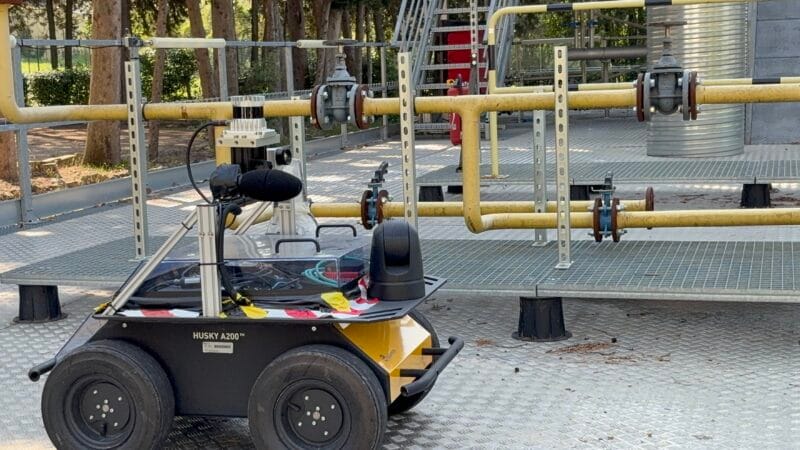
Built by Technip Energies in Marseille, Cyxense Commander is a proprietary supervision system platform that enables a single operator to remotely control and coordinate an entire fleet of mixed robotic devices, from ground crawlers and aerial drones to underwater vehicles, across unmanned or low-manned industrial sites. It supports everything from mission planning and simulation to autonomous navigation and hands-on manipulation of equipment like valves and electrical cabinets. Additionally, Cyxense Commander is built to connect with existing ICSS and CMMS systems, automating reporting, alarm management, and data flows, making it purpose-built for integration with asset integrity platforms like Cenosco’s IMS. In this pilot, Cyxense Commander served as the operational brain directing robots on the ground and feeding their data directly into Cenosco’s IMS.
This mission was a historic milestone for both companies. It marked the first time Technip Energies successfully interfaced its robotics with existing asset integrity software, and the first time Cenosco’s IMS received live data from a robot.
The pilot transformed the traditional “operating round” entirely. Imagine a robot at a major refinery, originally sent to perform a simple task: read a pressure gauge. In this new integrated workflow, however, the robot does much more. As it moves through the plant, supervised remotely by Cyxense Commander, the robot “scans” its surroundings, capturing high-frequency imagery and critical metadata, including camera orientation and field of view.
The Magic in the Cloud: From 2D Images to 3D Insights
This is where the technology shifts from “cool gadgetry” to “critical infrastructure.” The data captured by the robot and transmitted through Cyxense Commander is uploaded to secure cloud storage instantly. IMS then picks up these 2D images and, using the embedded metadata, superimposes them onto the plant’s 3D Digital Twin.

As a result, the system creates a “live” visual history of the asset. Whether through advanced AI algorithms or expert human review, issues like pipe cracks, corrosion, or insulation damage are identified and annotated directly on the image.
Because the 3D model is mapped to the IMS database, the system knows exactly which equipment is affected. It then generates an Equipment Condition History (ECH), a permanent, auditable record of inspection results, maintenance activities, and findings across the asset’s lifecycle. This, in turn, triggers a Corrective Action Inspection Request (CAIR) that flows seamlessly into SAP or the facility’s CMMS.

This integration also assists with planning. By seeing the issue in 3D, teams can immediately determine if scaffolding is required (e.g., if a repair is 3 meters high) before ever leaving the office. The entire process happens remotely. Which means that no permits, no human field presence, and no manual file exchanges are required. It’s a seamless real-time interaction.
A Multi-Layered Value Proposition
This robotic-AIM integration delivers value across the organization: Robotics improves how data is collected, while IMS improves how decisions are made, empowering teams at every level to drive safer, smarter operations, ultimately protecting production and margins.
- Robotics removes people from hazardous environments, eliminating exposure to trip-and-slip hazards. Repeatable inspections deliver higher-quality, more consistent data, improving defect detection and trending. As a result, data is automatically structured and linked to equipment, degradation mechanisms, and equipment condition history. This allows engineers to focus on assessing risk rather than chasing data.
- Better inspection prioritization increases coverage and frequency. Risk-ranked findings help teams focus on what matters most. Moreover, faster decisions flow directly from inspection data into assessments, planning, and execution, reducing delays between “finding” and “action.” One shared integrity view replaces siloed tools and spreadsheets across inspection, corrosion, maintenance, and operations. Consequently, teams spend less time organizing inspections and more time managing risk. This means fewer surprises, better planning, tighter control.
- More frequent, higher-quality inspections protect production and margins without requiring shutdowns. Teams identify and manage integrity risks earlier, reducing unplanned downtime. Lower enterprise risk and stronger license to operate come from digital inspection records, traceability, and risk-based decisions that improve auditability and regulatory confidence across the assets. Furthermore, digital inspection records and risk-based decisions strengthen auditability and regulatory confidence across assets. Earlier detection and better-targeted maintenance extend asset life and avoid premature replacement. In short, Cyxense Commander integrated with IMS protects revenue today and asset value tomorrow.

The New Standard: Better Data In, Clearer Decisions Out
The true impact of this partnership lies in the fundamental transformation of daily operations. While a robot’s primary mission may be a routine check of a gauge reading, the breakthrough is the “incidental” inspection it performs at the same time. As it navigates the deck, the robot captures a constant visual truth of the site. Therefore, every round becomes an integrity-building mission.
From a practical standpoint, this allows an operator to manage the facility’s health entirely from the safety of an office or trailer. By eliminating manual file exchanges and human field presence, the system removes the need for work permits and traditional logistics for basic checks. Much like drone technology has drastically reduced costs in the energy sector, this robotic-AIM integration brings that same level of massive cost-efficiency and safety to the ground level, providing a seamless, automated loop between the field and the office.
The partnership between Cenosco and Technip Energies marks a first for both companies. Cyxense Commander improves how data is collected; IMS improves how decisions are made. Together, they are building a safer, more predictable future for the global energy infrastructure.
Solicite una demostración
Are you ready to see the Cenosco & Technip Live Robotic-AIM Integration live? Fill out the form below to book a demo!

Denis Tkalec Technical Writer
Denis Tkalec is a technical writer at Cenosco, specializing in asset integrity management software since 2022. With a background in education and six years in marketing, she turns complex topics into clear, user-friendly content. Inspired by Camus’s belief that “a writer keeps civilization from destroying itself,” she brings precision and care to every manual.