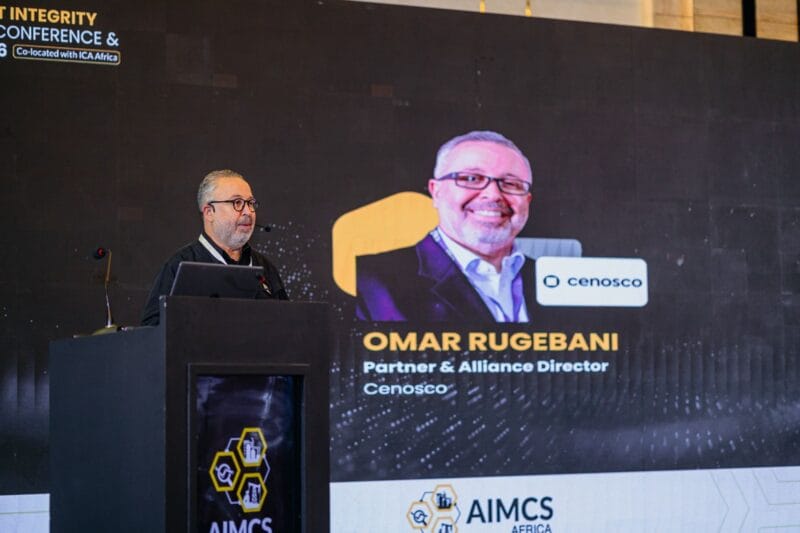
For inspection and RBI teams responsible for mechanical integrity in oil and gas facilities, deadlegs in piping systems are a classic mechanical integrity threat. They appear minor on P&IDs but become major field challenges, as Omar Rugebani highlighted at the Africa Asset Integrity Management Conference & Showcase (AIMCS Africa 2026) in New Cairo, Egypt.
The reason deadlegs pose a significant risk to an operating facility is the low or no flow that allows corrodents to settle, reducing the effectiveness of inhibitors or biocides, and accelerating damage that is often highly localized. This combination increases the likelihood of loss of containment and, just as importantly, reduces inspection confidence if the inspection team applies the same point measurement logic they use for a flowing process fluid.
What Are Deadlegs in Piping
Before we go any further, a practical starting point is to be precise about deadleg management.
Deadlegs are commonly defined as piping components with little to no significant flow. They are of three main types:
- Permanent Deadlegs (long-term stagnation areas),
- Operational Deadlegs (stagnant for operational reasons),
- Mothballed (equipment/piping removed from service).
The Energy Institute definition expands on this definition for oil and gas integrity, specifying what matters for degradation. A deadleg is a section of pipe work or vessel which contains hydrocarbon fluids and/or water under stagnant conditions (either permanently or intermittently), or where there is no measurable flow.
Why Deadleg Management Matters
A single leak from a deadleg can escalate into catastrophic failure, triggering severe safety and environmental incidents. These areas are prone to accelerated corrosion, with damage appearing extremely localized and proving difficult to detect effectively. Stagnant fluids promote bacterial growth on internal surfaces, heightening integrity risks. Typically overlooked as non-operational priorities since their contents sit outside the main process stream, deadlegs demand dedicated management to safeguard facilities.
Deadleg Identification
A robust deadleg program starts with accurate identification to build a reliable inventory. Follow these proven steps:
- Identify Probable Deadlegs: Review P&IDs, piping isometrics, corrosion loops, and related documents to pinpoint potential deadlegs.
- Field Validation: Verify identified deadlegs on-site, and conduct field rounds to spot additional ones missed in drawings.
- Confirm Deadlegs: Review the full list with a multidisciplinary team to validate and finalize it.
- Maintain Deadleg Register: Load and maintain the confirmed deadlegs in your CMMS or Asset Integrity Management System for ongoing tracking.
This systematic process ensures nothing slips through the cracks, bridging P&ID theory with field reality.
Degradation Mechanisms Causing Deadleg Failures
Before we can start managing deadlegs, it’s important to understand the degradation mechanisms at play. Under stagnant conditions, two degradation mechanisms are consistently observed in the field across oil and gas deadleg piping: Microbiologically Induced Corrosion (MIC) and Under Deposit Corrosion (UDC).
Microbiologically Induced Corrosion (MIC)
MIC is corrosion caused or accelerated by microorganisms such as bacteria, algae, and fungi, typically promoted by stagnant or low-flow conditions.
- Affected Materials: Primarily carbon steels and alloy steels; however, stainless steels can also be susceptible to MIC.
- Main Cause: Sulfate-reducing bacteria (SRB) produce corrosive sulfides, while other microbes generate organic acids that accelerate corrosion.
- Key process parameters to monitor: Flow rate, oxygen concentration.
- Prevention Methods: Periodic flushing, biocide treatment, and cathodic protection (CP) for underground lines.
Under Deposit Corrosion (UDC)
UDC is a highly localized and aggressive form of corrosion that develops beneath deposits on metal surfaces, typically in low-flow areas such as pipelines and boilers.
- Affected Materials: Mainly carbon steels and low-alloy steels.
- Main Cause: Differential aeration (concentration cell) corrosion occurs beneath deposits due to limited access to oxygen, making the covered area anodic. This leads to accelerated, localized wall thinning.
- Key process parameters to monitor: Flow rate, pH, temperature.
- Prevention Methods: Regular flushing, removal of dirt and deposits, and application of protective coatings.
Identifying deadlegs and understanding the degradation mechanisms involved is only the first step. Deadleg degradation needs to be actively managed. An effective approach for deadleg management is Risk-Based Inspection (RBI). RBI ensures that high-risk deadlegs are properly identified, prioritized, and managed with appropriate inspection and mitigation measures.
Proven 5-Step RBI Modeling Program for Deadleg Success
Effective RBI for deadlegs follows a structured 5-step process to ensure risk-based prioritization:
- Classify Deadlegs: Determine if deadlegs are corrosive or normal (non-corrosive).
- Criticality Assessment: Evaluate susceptibility to failure and consequence of failure using qualitative or quantitative methods.
- Review Inspection History: Where possible assess past inspection confidence levels and calculated remaining life for each deadleg.
- Set Inspection Intervals: Establish intervals based on criticality ratings, inspection confidence, and remnant life analysis.
- Plan Targeted Inspections: Develop inspection plans aligned with RBI-determined intervals and risk priorities.
Although Risk-Based Inspection (RBI) is already a good strategy, active risk mitigation measures are recommended to reduce deadleg risks.
Risk Mitigation Strategies
Risk mitigation is typically achieved through a combination of monitoring, operational controls, design improvements, and inspection. Together, these measures help reduce both the likelihood and the consequences of the deadleg degradation mechanisms.
Monitoring process conditions is critical for managing deadleg integrity. Integrity Operating Windows (IOWs) should be actively tracked to ensure operating conditions remain within safe limits. If an excursion occurs, an inspection should be conducted to determine whether a corrective action is needed. For microbiologically induced corrosion (MIC), key parameters to monitor include flow rate and oxygen concentration. In the case of under-deposit corrosion (UDC), monitoring flow rate, pH, and temperature is particularly important.
Operational controls help prevent stagnant conditions that promote corrosion. Regular flushing of deadlegs should be implemented where feasible. In addition, the use of corrosion inhibitors and biocide treatments can be effective in reducing the risk of both general corrosion and microbiologically induced corrosion, depending on the service and operating environment.
Material upgrades may be justified for deadlegs with a history of corrosion or a high-risk profile. In such cases, upgrading to higher alloy steels can improve resistance to corrosion, provided the decision is supported by a cost-benefit analysis and aligned with the overall integrity management strategy.
Design improvements can significantly reduce deadleg risk. Where possible, deadlegs should be redesigned to be self-draining to avoid stagnant conditions. Small-bore connections (SBCs) that create unnecessary deadlegs should be removed or redesigned to minimize corrosion-prone geometries.
Eliminating a deadleg altogether removes the corrosion risk associated with that section and is often the most effective long-term solution. While elimination may not always be practical, it should be considered during modifications, revamps, or brownfield projects.
Inspection remains an essential component of deadleg management. Inspections should be planned based on RBI intervals and the risk profile of each deadleg. Appropriate techniques include visual inspection, ultrasonic testing (UT), and profile radiography, selected based on accessibility, expected damage mechanisms, and required confidence level.
Emerging Digital Tools for Deadleg Management
Digital tools are increasingly useful for decision making on deadleg management. They reduce uncertainty, especially where access is poor and consequences are high.
The most practical applications are:
- Digital Twin: Use digital twins to monitor real-time corrosion rates on deadlegs. By integrating ultrasonic testing (UT) sensor data and tracking excursions, operators can gain a live view of integrity conditions and detect early signs of degradation.
- Predictive Analytics: Use recorded operational parameters and thickness measurements to predict potential failures. Machine learning algorithms can analyze historical and real-time data to forecast risk and optimize maintenance planning.
- Advanced Ultrasonic and Imaging Techniques: Apply advanced nondestructive testing (NDT) methods, such as phased array ultrasonic testing (PAUT) and digital profile radiography, to assess deadleg integrity with high precision.
- Remote Drone Inspection: Employ drones to inspect hard-to-reach or hazardous areas. Equipped with cameras and UT sensors, drones can perform both visual and ultrasonic inspections, reducing risk to personnel and improving inspection coverage.
These technologies are best treated as force multipliers for a disciplined workflow, not as substitutes for inventory quality, mechanism screening, and fit for purpose inspection coverage.
Deadleg Management in Action with IMS PEI
Cenosco’s IMS PEI (Pressure Equipment Integrity) module transforms deadleg theory into executable workflows through structured S-RBI processes. Rather than treating deadlegs as footnotes in parent piping circuits, IMS PEI models them as standalone components. When a component is identified as a corrosive deadleg, IMS PEI enables you to assign a Deadleg Analysis, allowing a dedicated deadleg-focused RBI assessment to be carried out.
IMS PEI supports the five-step RBI program outlined above as follows:
1. Classify Deadlegs
IMS PEI allows you to treat deadlegs differently based on their classification. Corrosive deadlegs can be tracked in a circuit separate from the mainline piping, while normal (noncorrosive) deadlegs are typically inspected as part of the main piping. For corrosive deadlegs, IMS also helps you assess their stability and provides riskbased inspection guidance accordingly.
2. Critical Assessment
IMS PEI guides you in determining the Susceptibility to Failure (StF) rating (H, M, L, or N). This susceptibility rating is then combined with the consequence of failure within the RBI logic to produce an overall criticality rating that drives inspection and mitigation priorities. For unstable, corrosive deadlegs, the StF is calculated based on the difference between the Potential Corrosive Rate of the Deadleg (PCRD) and the Design Corrosion Rate (DCR) of the parent piping.
3. Review Inspection History
In IMS PEI, Corrosive Deadlegs can be tracked in a Circuit separate from the mainline piping. Small diameter branch connections, e.g., vents, drains, and bleeders, should be put in one or more separate Deadleg Circuits. Wall thickness measurements can then be captured at Condition Monitoring Locations (CMLs) selected to be representative of these connections, considering the potential and extent of deadleg corrosion. This ensures that inspection history is properly recorded and can be easily reviewed.
4. Set Inspection Intervals
For unstable, corrosive deadlegs, assessing remaining life and inspection confidence can be challenging. In these cases, IMS PEI uses Criticality Lookup Tables to assign an Inspection Strategy (IS) Class—A (≤1 year), B (≤2 years), or C (≤3 years)—along with a corresponding Maximum Inspection Interval (MII). Low-criticality deadlegs, by contrast, can be treated as stable and noncorrosive. For these, IMS recommends applying a standard RBI approach, allowing you to transition from a Deadleg Analysis to a conventional RBI analysis. The standard RBI then calculates an Interval Factor, which is combined with the deadleg’s remaining life to determine the next inspection date.
5. Plan Targeted Inspections
In IMS PEI, RBI results can be assigned to both corrosion and inspection schedules. For unstable, corrosive deadlegs, these schedules can also be tagged with their corresponding IS Class (A, B, or C). This ensures that inspection intervals and corrosion monitoring intervals are directly driven by RBI outcomes.

The systematic approach that IMS PEI follows eliminates the inefficiency of ‘inspecting everything’ and instead optimizes deadleg inspections based on their risk.
Schedule an IMS PEI demo to experience deadleg workflows tailored for oil and gas asset integrity.
申请演示
Fill out the form below to get your IMS Journey started.