
If you’ve ever had to perform a Reliability Centered Maintenance (RCM) analysis, you know how much time, resources, and work it takes to complete one. The goal is to streamline the process, reduce the number of workshops, and minimize expert hours while maintaining technical integrity. To achieve it, you need to tackle from various sides.
Using maintenance strategy libraries and creating basic task sets represent some of the ways organizations can simplify RCM applications without compromising effectiveness.
What is Streamlined RCM?
Streamlined RCM is a structured approach to applying Reliability Centered Maintenance with reduced resource demand, fewer workshops, less expert time, and lower analytical overhead, while preserving the risk-based logic and technical integrity that make RCM effective.
In practice, this means shifting away from conducting full, from-scratch analyses for every asset, and toward using a combination of the three core techniques discussed in this article:
- Risk-based segmentation: applying full analytical depth only where failure consequences justify it
- Maintenance strategy libraries: reusing standardized templates for common equipment types
- Predefined task sets: defining minimum maintenance packages for lower-criticality assets
Together, these approaches allow organizations to reduce workshop effort without compromising the reliability outcomes that RCM is designed to deliver.
Applying the Seven RCM Questions More Efficiently
The seven questions of RCM, structured by J. Moubray in the nineties, remain the backbone of any RCM analysis. They define the asset, identify how and why it can fail, trace how degradation begins and progresses, assess the probability and consequence of each failure, and select appropriate maintenance tasks.
For a streamlined RCM approach, these seven questions remain. The goal is to answer them more efficiently by using standardized data, predefined failure modes, and risk-based decision logic rather than building every answer from scratch in a workshop setting.
How Streamlined RCM Reduces Resource Demand
It takes time, knowledge, and data to answer the seven questions thoroughly. A proper Reliability Centered Maintenance study typically entails:
- A skilled RCM facilitator
- A multidisciplinary team from mechanical, rotating, electrical, instrumentation and operations.
- Multi-day workshops for each system
- Detailed documentation and validation
While the rigor of this process ensures quality and traceability, it also demands significant organizational commitment.
Today, most companies must balance competing priorities, reduce costs, and accelerate projects. Maintenance strategies are no exception: organizations across the industry are trying to streamline maintenance processes and optimize the use of resources. With analyses as complex as RCM, the challenge lies in determining whether structured simplifications can maintain acceptable reliability performance while lowering time and cost.
Strategic Simplification of Reliability Centered Maintenance
One way to accelerate the RCM process is by selectively skipping or streamlining certain questions such as:
- Standardizing asset functions for common equipment types.
- Using predefined failure modes based on historical data.
- Applying predefined decision logic for low-risk assets.
Instead of building every analysis from scratch, organizations can rely on experience captured in maintenance strategy libraries. This approach shifts part of the effort from workshop-based analysis to knowledge-based standardization.
Maintenance Strategy Libraries
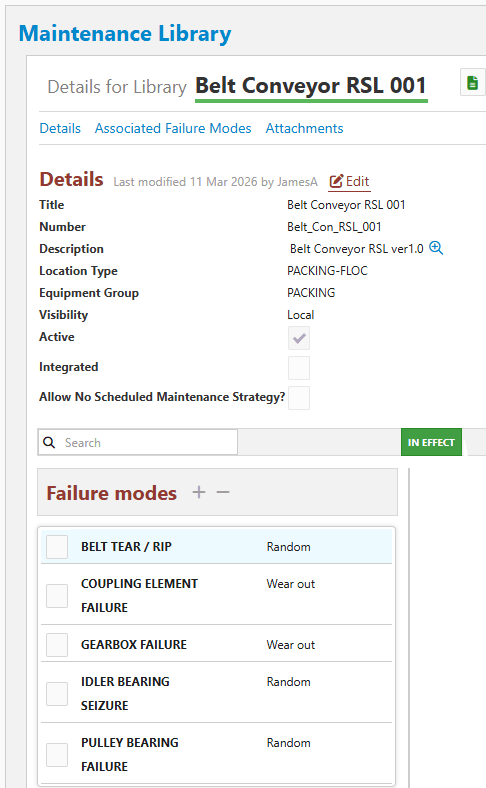
A maintenance strategy library is a building block containing predefined maintenance templates for common equipment types such as centrifugal pumps, control valves, heat exchangers and electric motors. Such libraries may include typical functions, common failure modes, standard preventive tasks, suggested inspection intervals, and condition monitoring techniques for each equipment category.
By leveraging such a library, organizations avoid repeatedly analyzing similar assets from scratch. This approach significantly reduces resource demand by minimizing workshop preparation, reducing expert hours, and accelerating template assignment. It also improves consistency across sites and projects.
Maintenance strategy libraries shift effort from repeated analysis toward repeatable engineering decisions.
Defining Basic Task Sets
You can streamline the RCM process further by defining minimum or “basic” maintenance task packages for selected asset categories. These packages typically include visual inspections, lubrication tasks, functional testing, and basic condition monitoring.
The Trade-Off: What’s the Price of Using Less?
While simplification offers efficiency gains, it also carries risks. Skipping early RCM analysis steps can weaken the risk-based foundation of the methodology and possibly result in spending resources and effort on low critical equipment. The most obvious potential pitfalls include over-maintenance, maintenance-induced failures, and hidden failure risks.
Over-maintenance
Without detailed failure mode analysis, there is a tendency to apply conservative maintenance tasks “just in case.” This can result in unnecessary inspections, excessive operational disturbance, increased spare parts consumption, and higher labor demand.
Over-maintenance not only increases costs but can also reduce availability by introducing unnecessary downtime.
Maintenance-induced Failures
Every maintenance intervention carries risk. Stopping and starting equipment, safely opening equipment, replacing components, or performing intrusive inspections can introduce new defects such as exposure to hazards, contamination during intervention, incorrect reassembly, calibration errors, and run-in faults.
If failure mechanisms do not clearly justify maintenance tasks, they may increase failure probability instead of reducing it.
Hidden Failure Risks
Skipping detailed consequence analyses may lead to underestimating certain failure impacts. Particularly in safety-critical systems, insufficient analysis can expose the organization to regulatory non-compliance, environmental incidents, production losses, and reputational damage. These are some of the reasons for companies to approach optimization carefully, selectively, and intelligently.
When to Apply Streamlined RCM
A practical approach to streamlining maintenance strategies lies in segmenting assets by criticality.
- High criticality equipment, such as assets with safety or environmental implications, still warrants full RCM analysis, as the engineering effort is minimal compared to the potential consequences of failure.
- Medium criticality assets, including production critical equipment, can often benefit from a partial RCM supported by standardized maintenance libraries.
- Predefined minimal maintenance strategies are typically sufficient for low criticality or non-critical support assets.
This tiered, hybrid approach ensures companies apply analytical depth where it delivers the greatest value. It enables organizations to allocate resources more effectively while maintaining appropriate levels of reliability.
Finally, this approach is particularly useful for reliability engineers, maintenance planners, integrity teams, and Technical Authorities responsible for large asset populations across multiple sites.
When Full RCM Analysis Is Still Necessary
Despite the benefits of simplification, some equipment categories still require a complete Reliability Centered Maintenance analysis.
This is particularly true for:
- safety-critical systems,
- environmentally sensitive assets,
- equipment with complex failure behavior,
- systems governed by strict regulatory requirements.
In these cases, the engineering effort associated with a full RCM workshop is justified by the potential operational and safety consequences of failure.
The goal of streamlined RCM is not to eliminate engineering rigor, but to apply analytical effort where it delivers the greatest value.
Reliability Centered Maintenance remains one of the most structured and technically sound approaches to maintenance optimization, but traditional RCM studies can require substantial time and organizational effort.
By combining risk-based segmentation, maintenance strategy libraries, and standardized workflows, organizations can streamline RCM implementation while maintaining technical consistency and traceability.
How IMS RCM Supports Streamlined Maintenance Strategies
Cenosco’s IMS RCM is a cloud-based Reliability Centered Maintenance software solution that helps improve asset availability and prevent unplanned failures by optimizing maintenance activities while balancing safety and cost efficiency. The IMS RCM tool supports both full Reliability Centered Maintenance studies and simplified maintenance strategies based on standardized workflows, enabling organizations to implement effective and budget-friendly maintenance practices.
Teams can:
- reuse maintenance strategy libraries,
- standardize failure modes,
- apply predefined task templates,
- document risk-based decisions,
- maintain traceability across sites and projects.
This helps organizations reduce repeated workshop effort while preserving consistency and engineering oversight. The approach is particularly valuable for organizations managing large populations of similar equipment such as pumps, motors, valves, and heat exchangers.
References
J. Moubray, RCM II: Reliability-Centered Maintenance, 2nd ed., Oxford, 1997, pp. 7 – 16.
Bereit für eine Demo?
Discover how IMS RCM helps teams streamline RCM, reduce effort in workshops, and maintain engineering rigor. Book a demo.

Jan Ruk Technical Writer
Jan is a Senior Technical Writer focused on creating, managing, and improving technical documentation processes. He enjoys research, optimizing workflows, and finding ways to improve content quality and efficiency. He holds a Master’s degree in English and Spanish Language and Literature. Outside of work, he enjoys reading short stories, traveling, and hopes to visit Iceland, Japan, and Bolivia one day.