Bringing facilities safely back online can be challenging. Some facilities go quiet gradually, through a slow wind-down of production targets, reduced staffing, and deferred maintenance cycles. Others stop operating almost overnight. Planned turnarounds, natural disasters, economic downturns, and geopolitical instability all produce the same operational reality regardless of what triggers it.
Operational resilience becomes the defining challenge the moment a facility needs to come back online. And asset recovery becomes the process through which that resilience is either built or lost. At some point, the teams responsible for those assets will have to assess what it takes to bring them back safely. The quality of that answer depends entirely on the integrity data available to them at that moment.
That is the real challenge for integrity and reliability teams in high-risk environments. Not the disruption itself, but what it leaves behind. One consequence stands out above the rest: the inspection and maintenance backlog that accumulates during downtime frequently becomes a greater operational threat than the original shutdown trigger.
The Problem with Data When Everything Stops
The visible damage gets addressed. What tends to be underestimated, however, is how much a prolonged outage degrades integrity data across an asset. That degradation matters enormously when the restart decisions need to be made.
When operations slow down or halt entirely, the structured rhythms of integrity work break down with them:
- Inspection cycles that were scheduled against a running asset no longer apply cleanly.
- Condition monitoring data stops accumulating or becomes unreliable.
- Maintenance work orders planned against an operating baseline get deferred.
- The traceability between what was planned, what was done, and what was found starts to erode.
Why Data Quality Determines Asset Recovery Success
By the time a facility is preparing for restart, integrity and reliability teams are often working from an asset condition picture that is months out of date. Maintenance records sit in isolation from inspection reports. Condition assessments live in spreadsheets on individual laptops. And the most reliable source of truth about an asset’s history is often the memory of two or three engineers, knowledge that disappears if those people are unavailable during a crisis.
That fragility has direct consequences for return-to-service decisions. Fit-for-purpose assessments, risk-based prioritization, and restart screening all depend on a consolidated, accurate view of asset condition. When that view is missing, decisions rest on incomplete information, and the likelihood of costly mistakes early in the restart process increases.
The foundational question for any integrity team preparing for a restart is straightforward. What is the actual current condition of this equipment, and what evidence supports that assessment?
In practice, answering it rigorously means pulling together:
- inspection records,
- thickness measurement histories,
- corrosion findings,
- maintenance event logs,
- and outstanding work orders from across the asset.
A centralized integrity management system addresses this directly. It replaces fragmented, individually held data with a structured equipment condition history owned by the organization and accessible when needed most.

Asset Recovery and the Backlog Problem
The inspection and maintenance backlog is one of the most consistently underestimated aspects of operational recovery. It builds up quietly during reduced or halted operations. And in many cases, managing it effectively is a more complex challenge than addressing the physical damage that triggered the outage.
Extended downtime creates several distinct backlog problems:
- Deferred inspections across pressure equipment, piping circuits, rotating machinery, and safety instrumented systems.
- Outdated RBI reassessment intervals calibrated for a running asset that no longer reflect actual operating history.
- Accumulated preventive maintenance tasks that have gone unfinished, whether scheduled by operating hours or calendar intervals.
- Degradation in idle fixed equipment caused by temperature fluctuations, moisture ingress, partial inventory, and static loads, often invisible and outside any pre-outage inspection scope.
When teams start to get back on track, the instinct is usually to address the most visible problems first. That is understandable given the pressure to show progress, but it carries a real risk. Some of the highest-consequence items are precisely those where the condition is genuinely unknown.
For example, a vessel with a recently recorded and monitored finding is, in some respects, less concerning than one where the last valid inspection is overdue and the intervening operating and storage conditions are not well understood.
The Hidden Risk of “Unknown Condition” Assets
Risk-based prioritization provides a systematic methodology for working through this. You assess each asset against probability of failure and consequence of failure. That assessment drives the sequence of backlog clearance, based on actual risk rather than visibility or logistical convenience. The output is a prioritized work program that efficiently uses limited inspection and maintenance resources.
Recovery as a Foundation for Operational Resilience
Organizations that come through major disruption in the strongest position tend to have done something specific during the recovery phase. They used it to rebuild their integrity data foundation rather than patch over what was missing and move on.
The quality of ongoing integrity management depends directly on the quality of the underlying data. For instance, a preventive maintenance program built on accurate, current condition data performs better than one inherited from a pre‑disruption baseline and applied without reassessment. Similarly, an RBI program that reflects the asset’s current risk profile is more effective than one carried forward from an earlier, different operational context.
Once assets are back online and the immediate recovery pressure eases, you can build toward something more durable:
- Maintenance strategies grounded in current condition data.
- RBI reassessments tha incorporate findings from the recovery phase.
- Reliability programs that treat the disruption as a data point rather than a gap to minimize.
As a result, the compounding returns of doing this well are tangible. Unplanned downtime drops. Regulatory compliance strengthens. Institutional knowledge no longer walks out the door every time a key person leaves.
Governance, Transparency, and the Burden of Proof
In high-risk industries, the burden of proof sits firmly with the operator. Regulators, insurers, and shareholders require documented evidence that an asset is safe to operate. During a recovery process, that requirement intensifies rather than relaxes.
A structured integrity management approach provides that evidence trail. It captures every inspection, every risk-based decision, and every finding in a way that is auditable and accessible. Organizations that can point to a complete record of what they assessed, what they found, and how they made decisions stand in a fundamentally different position. Reconstructing rationale after the fact, whether in front of a regulator, an insurer, or internal leadership, is a position no one wants to be in.
Transparency also changes how organizations manage stakeholder expectations during recovery. Knowing the actual status of critical inspections and repairs, having reliable data on which assets are cleared for restart, and which are not, and communicating that clearly across the organization are significant operational advantages, particularly in environments where trust and credibility are already under pressure.
How Cenosco IMS Supports Asset Recovery
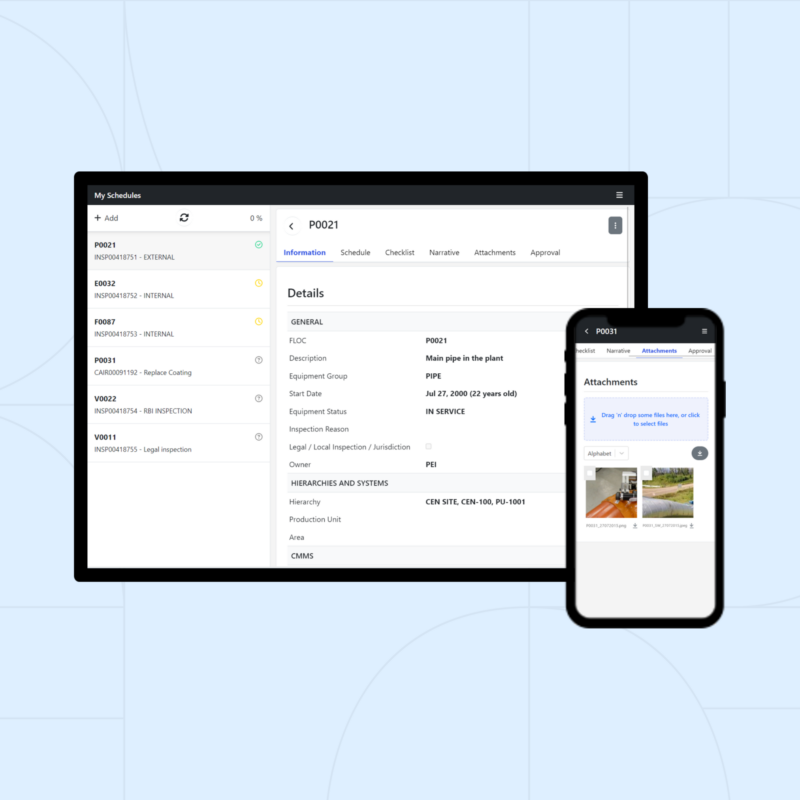
IMS (Integrity Management System) gives integrity and reliability teams a single, traceable data foundation for recovery. It consolidates inspection and maintenance findings into a full condition picture, supports fit-for-purpose and return-to-service assessments, and helps prioritize the backlog using RBI and RCM principles. Operational, engineering, and project teams manage the restart itself. What IMS provides is the integrity and reliability side of that process: clear, auditable, and defensible.
Three modules play a central role:
- PEI (Pressure Equipment Integrity) structures recovery for vessels, piping circuits, and other critical assets. It tracks condition degradation during downtime and integrates with RBI to drive inspection planning and disposition decisions, focusing effort on the highest-risk equipment.
- PLSS (Pipeline and Subsea Systems) manages pipeline and subsea integrity during recovery. It handles In-Line Inspection data, supports fit-for-service calculations, and helps teams assess the condition of assets that have been idle or operating under abnormal conditions.
- Reliability Centered Maintenance (RCM) sorts the maintenance backlog by risk, criticality, and condition, giving recovery work a clear, defensible sequence rather than one driven by convenience.
- SIS (Safety Instrumented Systems) brings inspection results, testing records, and functional verification together to confirm that safety-critical functions perform as intended before restart.
IMS in a Recovery Context: Key Capabilities
In practice, IMS helps you turn recovery into a structured integrity and risk exercise by:
- Integrating Inspection Data Management, Risk-Based Inspection (RBI), and Reliability Centered Maintenance (RCM), and statistical analysis into one environment, so risk-based methods stay aligned across the asset lifecycle.
- Building equipment condition histories and dashboards that show not just what was inspected, but how findings, leaks, temporary repairs, and maintenance events have evolved over time.
- Supporting CMMS integration and mobile field work, so data captured on-site feeds directly into the central asset register, even in low-connectivity environments.
- Generating risk-based schedules and compliance-ready records that provide auditable evidence behind every restart decision.
Recovery is rarely a straight line, but the organizations that navigate it best share one thing in common: they go into it with their data in order. IMS gives integrity and reliability teams the foundation to do exactly that.
Ready for a Demo?
Want to see how IMS supports safe return-to-service and risk-based recovery? Fill out the form below to book a demo!

Denis Tkalec Technical writer
Denis Tkalec is a technical writer at Cenosco, specializing in asset integrity management software since 2022. With a background in education and six years in marketing, she turns complex topics into clear, user-friendly content. Inspired by Camus’s belief that “a writer keeps civilization from destroying itself,” she brings precision and care to every manual.