IMS (Integrity Management Software) is continually evolving, driven by a long-term vision to transform how organizations manage asset integrity, reliability, and safety. The challenge today is complexity and fragmentation, where engineers spend more time managing information than acting on it. For Cenosco, the goal is a future where engineers transcend manual processes, asset health is continuously visible across the entire enterprise, and predictive insights drive operational excellence.
To get there, IMS is doubling down on what asset-intensive organizations depend on most: innovative technology, increasing productivity, and regulatory compliance. In 2026, that commitment takes the platform from a system of recording to one of prediction and autonomy.
Here is everything coming this year.

Managing Anomalies in Subsea Pipelines and Remote Infrastructure
One of the most prominent new functionalities in 2026 is advanced anomaly management. Originally introduced within the IMS PLSS (Pipeline and Subsystems), this capability is now being expanded into a general anomaly management functionality applicable to both upstream and downstream operations. As infrastructures expand, especially underwater pipelines and remote assets, the ability to detect, track, and respond to anomalies becomes essential. Once in place, this functionality will help teams stay ahead of evolving issues, reducing risk and maintaining system integrity before problems escalate. It will also bring greater visibility to temporary repairs across the entire asset lifecycle.

Root Cause Analysis That Turns Incidents Into Institutional Knowledge
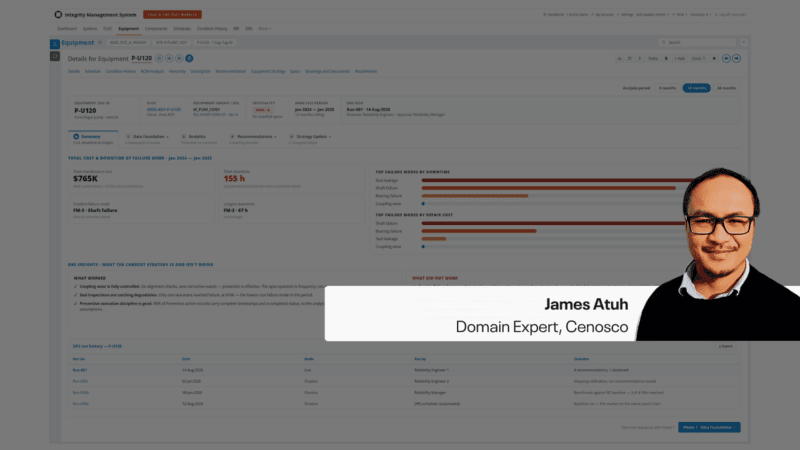
In asset-intensive industries, the same failure will keep happening until you understand exactly why it occurred in the first place. When things go wrong, IMS accelerates the journey to understanding what happened, why it happened, and what needs to be done. Smart root cause analysis will power that process, transforming past events into organization-wide knowledge. The result is faster troubleshooting, improved decision-making, and transparent tracking of follow-up actions.

Geographical Visualization for Faster, Smarter Decision-Making
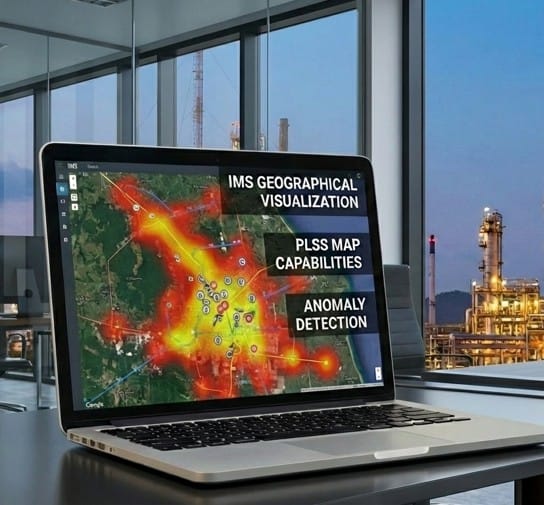
Information becomes truly powerful when placed in context. Visualizing it on maps can greatly help in understanding where focus is needed. That’s why IMS is introducing enhanced geographical visualization, starting with more advanced map capabilities in IMS PLSS. From pipelines to facilities to anomalies, teams can now understand where attention is needed at a glance. The result is visual clarity that drives quicker action across the board.
Keeping Risk Under Control with More API RBI Capabilities
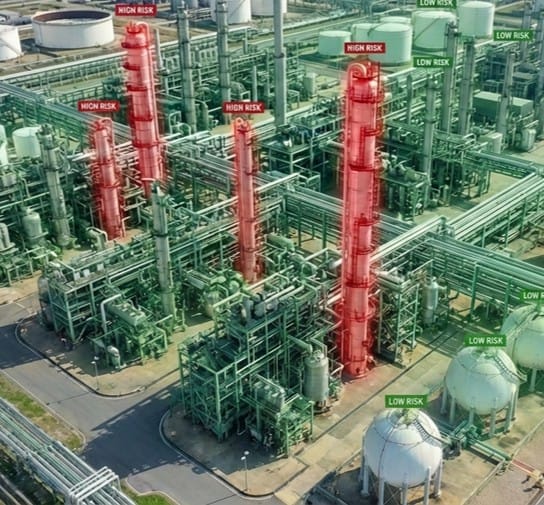
Risk-based inspection is at the heart of asset integrity, which is why IMS PEI (Pressure Equipment Integrity) is committed to maturing its API RBI capabilities in 2026, pushing alignment with API 581 and beyond. That progress unlocks new operational scenarios, expands reach into new industries. It also strengthens integration with the enterprise systems that rely on accurate, standards-driven RBI.
New Certifications that Support Broader Adoption
Alongside capability development, IMS continues to pursue globally recognized certifications that validate the platform against established technical and safety standards. In 2026, the focus includes:
- DNV RPF-101 and ASME B31G
- ASME VIII and ASME B31.3
- IEC 61508 / IEC 61511
- API 580
Each certification strengthens the trust that customers and regulators can place in IMS as a platform for asset integrity, reliability, and functional safety management. For the organizations that use it, that trust translates into something practical, a foundation that makes demonstrating compliance faster, more reliable, and less demanding.
Next-Generation IMS Middleware for More Reliable Integrations
As IMS continues to scale, the importance of reliable ERP and CMMS integration has necessitated reassessing the market and investing in a more suitable solution. In 2025, Cenosco developed the new IMS Middleware using Kafka technology. The first production deployment followed shortly after, marking a significant milestone.
Building on that foundation, 2026 will focus on extending the new middleware to more customers and transitioning away from the legacy solution. The new architecture delivers more robust, reliable communication between IMS and CMMS. This includes a built-in safety net that captures any messages that fail to reach their destination.
A Design Refresh Built for Usability at Scale
Alongside these structural changes, IMS is undergoing a design refresh to make the platform easier to use than ever before. Clearer navigation, fresher visuals, and more intuitive workflows help teams work faster, find insights quicker, and get more value from every feature. Simplicity drives adoption, and adoption drives impact. After all, powerful features only create value if people can find and use them.

The Future of IMS: A 10-Year Roadmap to Goal Zero
While 2026 brings a strong set of new capabilities, the vision for IMS goes even further. Cenosco’s long-term ambition is to achieve Goal Zero as an operating model. Getting there means evolving asset integrity management by combining human expertise, trusted engineering methods, and real-time asset intelligence. Cenosco maps that journey across three horizons.
Generative AI & Hyper-Connectivity
The next frontier for IMS is moving beyond dashboards and into intelligence. Cenosco has already taken the first step in this direction. In early 2025, the Condition History Summarization Tool was launched. It applies AI to automatically generate concise summaries of inspection histories at the equipment level. Building on that foundation, the broader vision is:
- Generative AI for Integrity, at the heart of which is an AI Copilot. It will enable teams to query decades of inspection reports, maintenance logs, and RBI data across the entire asset base to surface patterns and answer complex operational questions.
- Closed-loop integration between IMS and CMMS/ERP that will automatically trigger a work order when a high-risk finding is identified. In turn, the risk profile will be updated only once the repair has been verified in the field.
- Enhanced field mobility through Connected Worker tools, leveraging AR/VR for hands-free inspection guidance and real-time remote support, will bring this connected vision to life on the ground.
Physics-Based Digital Twins & Robotics
- IMS is evolving its product capabilities toward living digital twins that go far beyond static 3D models. By integrating real-time process data with corrosion models, IMS will be able to continuously predict asset degradation, eliminating reliance on fixed inspection cycles.
- Robotics-as-a-Service (RaaS) integration will add another layer, with native API support for autonomous drones and crawlers. Instead of manual data entry, the IMS will ingest raw sensor data from robots. It will automate computer vision for defect detection and populate the inspection report.
Multi-Asset Portfolios & Carbon Integrity
- As the energy transition accelerates, IMS is expanding its reach beyond hydrocarbons. The platform is evolving to manage the integrity of Carbon Capture and Storage pipelines, hydrogen storage facilities, and offshore wind structures. Each of these asset types presents unique challenges, including high CO2 corrosion environments that demand a new level of precision.
- Carbon integrity tracking is becoming a core part of that evolution. Moreover, environmental integrity is being embedded directly into the platform, connecting methane leak and CO2 emissions monitoring to regulatory compliance and carbon credits.
- Further down the road, total lifecycle autonomy will take IMS into strategic advisory territory. Organizations will be able to make informed retire-versus-repair decisions, driven by 10-year carbon tax forecasts, commodity prices, and real-time asset health.

What This Means in Practice
For engineering teams, the IMS 2026 Roadmap delivers on what makes day-to-day work less fragmented:
- nomaly management that keeps evolving issues visible,
- root cause analysis that connects events to corrective action,
- better maps for spatial understanding,
- more powerful RBI tools that align with current standards.
For leadership, the roadmap signals a platform that is becoming more predictive, more reliable, and more compliant. The combination of stronger technical infrastructure, proactive observability, pursuit of certification, and a maturing integration story means that IMS is increasingly positioned to serve as a trusted foundation for enterprise-wide asset integrity strategy, not just a tool individual teams use in isolation.
The IMS 2026 Roadmap does not promise to solve every problem at once. What it does reflect is a clear and consistent direction: building the platform that makes the Autonomous Plant concept achievable over the next decade, one well-engineered capability at a time.
Looking further ahead, the roadmap does not end in 2026. From Generative AI for Integrity and living digital twins to carbon integrity tracking and total lifecycle autonomy, Cenosco is building toward a future where IMS not only supports decision-making but drives it.
Which feature would most improve your asset integrity, reliability, or safety instrumented systems? Share ideas in the comments or vote on our Public Roadmap. Your feedback drives 2027 priorities!

Denis Tkalec Technical writer
Denis Tkalec is a technical writer at Cenosco, specializing in asset integrity management software since 2022. With a background in education and six years in marketing, she turns complex topics into clear, user-friendly content. Inspired by Camus’s belief that “a writer keeps civilization from destroying itself,” she brings precision and care to every manual.