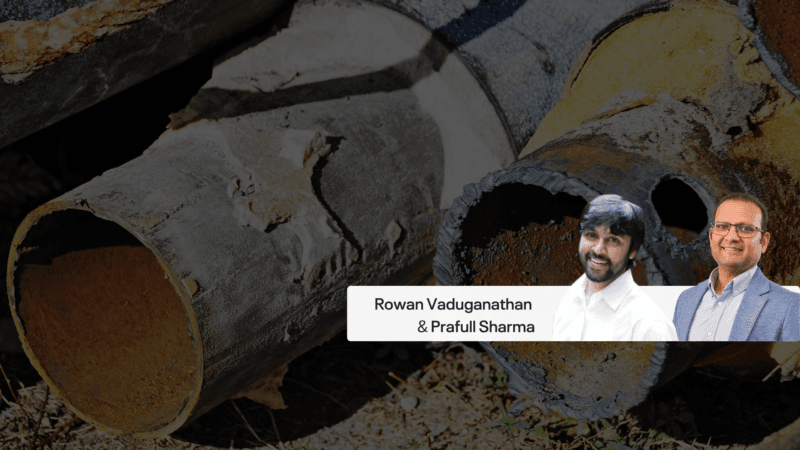
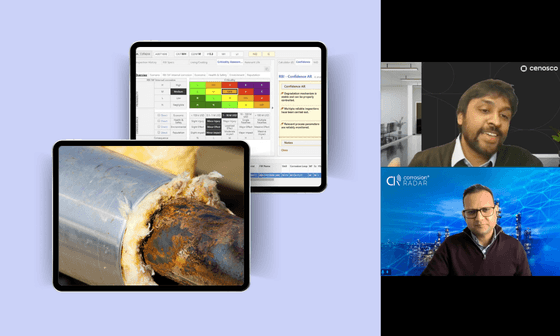
In a recent webinar hosted by Cenosco, in collaboration with CorrosionRADAR, Rowan Vaduganathan sat down with Prafull Sharma to unpack a question that continues to frustrate even the most experienced integrity professionals:
Why does corrosion under insulation (CUI) remain one of the industry’s most persistent challenges, despite decades of awareness, standards, and technological progress?
The answer, as it turns out, is both simple and deeply uncomfortable.
CUI has been on the industry’s radar for years. It’s documented, studied, standardized, and widely acknowledged as a critical threat to asset integrity. And yet, it continues to cause failures, often unexpectedly. During the discussion, Rowan shared a story about a mentor who had spent over four decades in corrosion management. When he began his career, CUI was already a major concern. When he retired, it still was. That continuity isn’t a coincidence, but a signal.
It suggests that while the industry has become better at recognizing CUI, it hasn’t fundamentally changed how it approaches it.
The Current State: High Expectations, Low Operational Relief
Across the oil & gas, chemical, and process industries, integrity teams face a familiar challenge: increasing asset age, rising inspection volumes, and growing expectations without a proportional increase in resources. Much of an engineer’s time is still spent on manual, low-value activities such as data consolidation, report writing, and navigating fragmented systems.
AI has not yet solved this problem at scale. A major reason is that many AI initiatives are introduced from the top down, driven by executive pressure rather than workflow realities. While leadership teams are rightly concerned about falling behind in AI adoption, engineers on the ground often see AI as disconnected from their day-to-day challenges.
The result is a mismatch: high strategic urgency, but limited day-to-day impact.
The Illusion of Control
Over time, the industry has layered solutions onto the problem. Better coatings, improved insulation materials, more advanced inspection techniques, risk-based methodologies. Each step has added value, but none have truly solved the issue.
Part of the problem lies in how CUI is framed.
It is often treated as a corrosion issue. In reality, it’s a system problem.
CUI sits at the intersection of design decisions, operational conditions, environmental exposure, and inspection practices. It is influenced by temperature fluctuations, insulation integrity, coating degradation, and even organizational silos between teams. And most critically, it develops in places we cannot easily see. That combination makes it inherently difficult to control.
Even today, there is no single, universally reliable way to predict where CUI will occur. It remains localized, unpredictable, and slow to reveal itself.
Why Traditional Approaches Fall Short
Conducting equipment inspections has long been the industry’s primary defense against CUI. The logic is straightforward: remove insulation, inspect the asset, and act if corrosion is found. But this approach comes at a cost, both operationally and strategically.
It is expensive, time-consuming, and inherently reactive. In many cases, organizations are inspecting vast areas only to confirm that nothing is wrong. Meanwhile, the actual risk may be developing elsewhere, unnoticed.
As Prafull pointed out during the session, CUI has a frustrating tendency to “find you before you find it.” It is not evenly distributed, it does not follow neat patterns, and it rarely announces itself early.
Risk-Based Inspection (RBI) frameworks have helped prioritize efforts, but they too have limitations. Many rely on static inputs and generalized assumptions, particularly around corrosion rates and operating conditions. In a world where assets operate dynamically, those assumptions can create blind spots.
The result is a gap between perceived risk and actual risk.
A Shift in Thinking: From Detection to Prediction
What emerged clearly from the discussion is that the industry is beginning to rethink its approach, not by refining existing methods, but by changing the objective entirely.
The goal is no longer just to detect corrosion; it is to understand the conditions that lead to it and intervene before it occurs. This shift is subtle, but profound.
Instead of asking, “Where is CUI happening?” the more powerful question becomes:
“Where is CUI likely to happen next?”
To answer that, organizations are starting to combine multiple sources of insight.
Machine vision technologies are enabling inspection at scale, capturing visual data across entire facilities and identifying early signs of insulation damage or coating failure. Monitoring systems are providing continuous visibility into conditions such as moisture presence and temperature fluctuations, factors that directly influence corrosion risk.
At the same time, advancements in analytics and AI are enabling connections among these signals that were previously infeasible. Data that once sat in silos, like inspection records, operating conditions, and environmental factors, can now be brought together to form a more complete picture of risk. This is where the real transformation begins.
From Static Risk to Living Intelligence
One of the most important ideas discussed in the webinar is the concept of dynamic risk.
Traditionally, risk models are built using historical data. They provide a snapshot, a moment in time. But assets don’t operate in snapshots. They operate continuously, under changing conditions. By integrating live data into risk models, organizations can move toward a more responsive understanding of their assets. Risk becomes something that evolves, not something that is periodically recalculated. This opens the door to something even more valuable: prescriptive decision-making.
Not just identifying where risk exists, but understanding what to do about it. Which assets to inspect. When to intervene. How to allocate resources most effectively. In other words, moving from insight to action.
Technology Is Not the Barrier
Despite all the progress, one theme stood out clearly: the challenge is no longer technological. The tools are emerging, the capabilities are real, and the direction is clear. The real barrier lies in adoption.
Too often, new technologies are treated as standalone solutions rather than part of a broader system. Pilots are conducted as isolated experiments instead of collaborative efforts to redefine how work gets done. Value is discussed in technical terms, rather than in the language of business impact, such as downtime avoided, failures prevented, costs reduced. For meaningful change to happen, this mindset needs to shift.
CUI management cannot be solved by vendors alone. It requires partnership between technology providers and operators, alignment across disciplines, and a willingness to rethink long-established practices.
The Simplest Insight Is Still the Most Powerful
Amid all the discussion around advanced technologies and predictive models, one point stood out for its simplicity:
The most effective way to prevent CUI is to question whether insulation is needed in the first place.
It’s an idea that challenges convention, but it reflects a deeper truth. Sometimes, the best solution is not to manage complexity, but to remove it.
Where the Industry Goes from Here
The challenge of CUI will not disappear overnight. It is too deeply embedded in the way assets are designed and operated. But the way it is managed is changing.
The industry is moving toward a future where:
- Inspection is targeted, not exhaustive
- Risk is dynamic, not static
- Decisions are guided by data, not assumptions
And perhaps most importantly: Where corrosion is no longer something we chase, but something we stay ahead of.
That shift won’t happen all at once. But for organizations willing to embrace it, the opportunity is clear. Not just to manage CUI more effectively, but to finally get ahead of it.
Ready for a Demo?
Are you ready to see the IMS Suite in action? Fill out the form below to book a demo!