Most refinery leadership teams can tell you exactly where the money is going. Turnaround scope keeps growing. Contractor costs keep climbing. The backlog never quite clears. And every year, the next shutdown is a little bigger and a little more expensive than the one before it.
This is the maintenance trap. The point at which a refinery’s turnaround program stops being a reliability strategy and starts being a cost spiral. Aging infrastructure, talent shortages, and inspection programs that have never been challenged against actual risk combine into a cycle that is hard to see and even harder to break: deferred maintenance drives larger turnarounds, larger turnarounds drive higher costs, and higher costs force further deferrals.
The operators pulling ahead are not spending more. They are questioning assumptions that have gone unchallenged for decades, deploying risk-based intelligence to focus effort where it actually matters, and systematically eliminating work that has been on the shutdown list for years without anyone asking whether it belongs there.
The Root Causes of Rising Turnaround Costs
You might have the industry’s top turnaround team, follow the strictest schedule, and oversee every contractor meticulously, yet costs will keep rising. Here’s why.
Aging Infrastructure
The average European refinery is 55 years old. As these assets age, the pattern is consistent: maintenance costs rise, refining margins decline, and backlogs keep growing.
Most of these facilities are still running inspection intervals determined by calendar schedules rather than actual degradation rates. An approach that may have been rational when the industry had no shortage of experienced people and inspection programs were far less costly to run. It is neither rational nor affordable today.

The Talent Crisis
The maintenance trap is not just an asset problem. It is a people problem.
The “Silver Tsunami”, a wave of experienced retirements driven by an aging workforce, has been removing decades of institutional knowledge from the industry. Following aggressive post-pandemic pay spikes, compensation inflation in the oil and gas sector remains high, driven by a severe technical talent shortage that shows no signs of easing.
Since 2022, compensation for mission-critical roles has risen by an average of 25%. And the specialized contractors your turnaround cannot run without, command significantly higher premiums on top of that.
Team are Operating Blind
Aging assets and shrinking workforces are visible problems. Leadership teams can see them, budget for them, and plan around them. The third force is harder to spot.
Without an orchestrated program for managing asset risk, operators have no reliable picture of what actually needs attention and what can wait. Scope grows unplanned. Shutdowns run longer than they should. Incident rates climb. And 30% of safety-critical maintenance tasks are already overdue past their deadline, while time and money continue to flow toward work that carries far less consequence.
“Inspecting everything regardless of risk is not conservatism. It is a failure of prioritization, and the industry pays for it every single turnaround.”
A 4-Pillar Path Out of the Maintenance Trap – Cenosco Playbook
Over 25 years and more than 300 supported assets across 40+ countries, Cenosco has refined a four-pillar playbook that consistently delivers turnaround cost reductions of 20% or more. Each pillar addresses a distinct failure mode in the conventional approach.
Pillar 1: Intelligent scoping with risk-based methodologies
Risk-Based Inspection (RBI) and Reliability Centered Maintenance (RCM) provide a single, integrated risk methodology to optimize inspection and maintenance decisions, reduce turnaround cost, and improve asset reliability.
Rather than calendar-driven schedules, the approach uses data-driven prioritization. Instead of asking, “When was this last inspected or repaired?”, we now ask, “What is the chance and impact of failure if we don’t inspect or repair now?”
Each piece of equipment is evaluated based on four consequence areas: asset value, people safety, environmental impact, and community effect. We then compare these against the failure probability to create a criticality rating. High-criticality items receive attention, while low-criticality items are postponed or removed from consideration.
This method supports gradual improvement. Organizations can begin with simple risk assessments and progress to more detailed, quantitative methods as their data and skills grow.
What this means in practice is:
- A clear prioritization of inspection and maintenance tasks,
- Fewer unexpected discoveries during turnarounds,
- Better spending focused on where failure has the biggest impact,
- Decisions that hold up against company standards and regulatory review.
In cases where Cenosco has used this method, scope reductions of 30% in North America and 50% in the Nordic region have been achieved, not through random cuts but through risk-based evidence.
Pillar 2: Scope Balancing Between Turnarounds and Ongoing Maintenance
The goal of scope balancing is to reduce turnaround cost and duration by shifting the right work out of TAs without increasing operational risk.
The reality is, not all inspection work requires a shutdown. On-stream inspection techniques can validate asset condition during normal operations, reducing dependency on the turnaround entirely.
Preventive and corrective maintenance activities (PM and CM) are scheduled and executed in the most cost-effective window rather than defaulting to the next TA. That way, only risk-critical discovery findings drive the TA scope. Routine or low-consequence work no longer automatically earns a place on the shutdown list.
The result is a turnaround that is leaner by design, not by compromise. Duration shrinks, contractor costs fall, and the critical path gets shorter because the work that ends up in the TA is genuinely the work that belongs there.
Pillar 3: Digitized Field Workflows
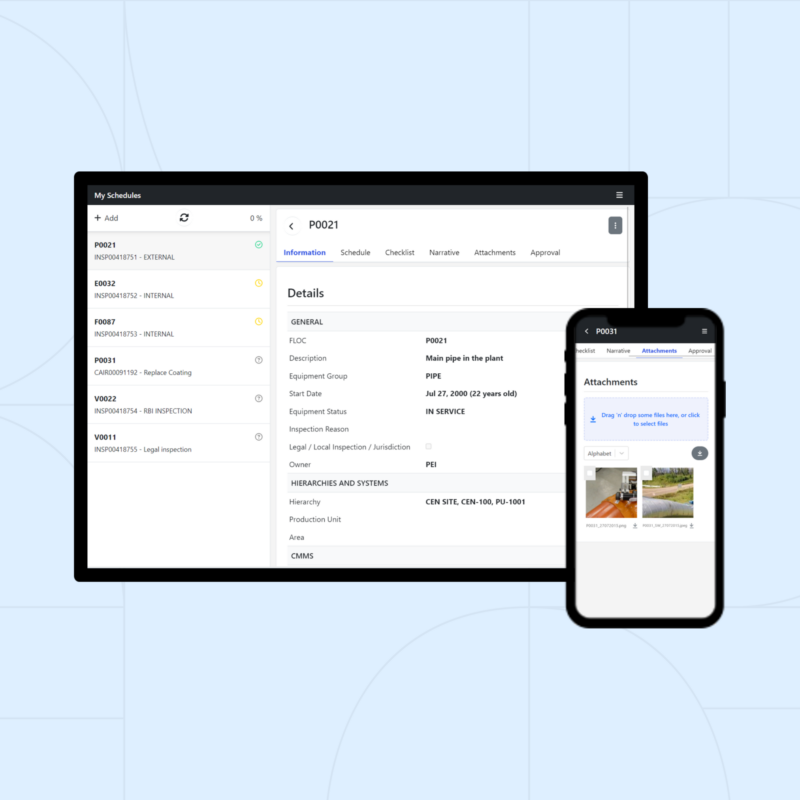
Cenosco’s digitized field workflows for TA and inspections turn field activity into faster decisions, lower risk, and measurable productivity gains.
Paper-based, spreadsheet-driven turnaround creates invisible inefficiencies: compliance gaps, traceability failures, and slow decision loops. Cenosco’s digitized field workflows address this directly by giving every inspector and contractor a structured digital process in the field, with findings captured in real time rather than transcribed from paper at the end of the day. That way, compliance gaps close, traceability improves, and the team gains enhanced visibility into TA progress.
The contractor workforce becomes more productive not because people work harder, but because the system finally works with them.
Pillar 4: Continuous Learning Loops
The most powerful long-term cost driver is institutional learning.
Every turnaround generates data on failure modes, root causes, and prescriptive mitigation actions. That knowledge becomes the foundation for data-driven decision-making across future TAs.
Organizations that systematically capture and apply it prevent recurring failures, lower TA costs over time, and achieve measurable risk reduction with each turnaround, those who don’t repeat the same mistakes and pay the same price indefinitely.
Cenosco’s 4-Pillar Turnaround Cost Optimization in Practice
Every asset is different. Every geography brings its own constraints, workforce dynamics, and regulatory environment. But when we work with operators to apply the 4-pillar strategy consistently, the results converge on the same core improvements: shorter durations, lower costs, and risk managed rather than discovered. The three client examples below show exactly how that played out in practice.
North American Refinery: 30% TA Scope Reduction
A 60-year-old North American refinery producing gasoline, diesel, and jet fuel had a problem most operators will recognize: the TA scope kept growing, and nobody could confidently say what actually needed to be there.
When you have limited visibility on equipment risk and degradation, the default answer is to inspect everything. So that is what they did, year after year.
Working with Cenosco, the team applied Intelligent Scoping and Continuous Learning Loops to challenge every item on the list. About 30% of the equipment was removed based on risk, condition, and inspection history.
Nordic refinery: 16% duration reduction, 50% scope removal
Even for a massive 226,000 bpd Nordic refinery with 50 years of legacy infrastructure, the Maintenance Trap is avoidable.
The refinery was running one of the most complex shutdowns in the industry, covering CDU, hydrotreating, hydrocracking, catalytic reforming, FCC, isomerization, and delayed coker. With over 500 critical heat exchangers, vessels, and tanks due for internal inspections, the scope was enormous.
The problem was not the complexity itself, but what was driving it. The majority of work was triggered by fixed intervals and extensive internal scope rather than actual equipment condition. Tube bundles were removed for cleaning even though the process did not require it. Every single tube bundle was inspected regardless of condition. Several of those inspections sat on the critical path, stretching the duration well beyond what the risk picture justified.
Through the application of Intelligent Scoping and Planning, Scope Balancing, and Continuous Learning Loops, they identified that half of their planned interventions added zero reliability value.
The result was a surgical 50% reduction in TA scope. His optimization translated directly into a 16% faster return to full production. In a margin-compressed industry, this represents both a significant maintenance win and a massive recovery of lost opportunity cost.
Asian Refinery: 14% Cost Reduction In 18 Months
The financial impact of Cenosco’s 4-Pillar Cost Optimization Playbook is even more pronounced in high-complexity assets, as evidenced by a 40-year-old, 300k bpd refinery in Asia. That’s one of the most complex asset configurations you will find anywhere.
It operated a crude plant, polypropylene plant, and aromatic complex, with reactors, heaters, and furnaces regularly driving the TA schedule. The inspection program was running on the wrong clock. Frequency was tied to TA cycles rather than to actual degradation rates. The asset experienced periods with limited visibility into equipment condition, and damage was often discovered late or after failure.
Applying Intelligent Scoping and Continuous Learning Loops directly addressed both problems: better risk visibility and a feedback loop that improved decision-making with every cycle. he result was a 14% reduction in planned TA costs within 18 months. The asset continues to enjoy further cost savings and is now integrating IMS with SAP S/4HANA.
IMS: The Digital Engine for the 4-Pillar strategy
The maintenance trap is not solved by working harder, cutting budgets, or hoping the next turnaround will go better than the last. It is solved by having the right intelligence, at the right time, about the right equipment. That is exactly what Cenosco’s Integrity Management System has been delivering for 25 years.
Our IMS (Integrity Management System) is what makes all four pillars work in practice. Risk-based scoping removes 30-50% of unnecessary TA scope. Scope balancing shifts work out of shutdowns without increasing operational risk. Digitized field workflows close compliance gaps and give teams real-time visibility. Continuous learning loops make every turnaround smarter than the one before it.
Trusted by Shell, Equinor, ADNOC, Santos, Borealis, and others across 40+ countries, it is a battle-tested system with 25 years of proven performance. Or organizations ready to move beyond the maintenance trap, IMS provides the structure to make it happen.
Ready for a Demo?
Are you ready to see the IMS Suite in action? Fill out the form below to book a demo!

Denis Tkalec Technical writer
Denis Tkalec is a technical writer at Cenosco, specializing in asset integrity management software since 2022. With a background in education and six years in marketing, she turns complex topics into clear, user-friendly content. Inspired by Camus’s belief that “a writer keeps civilization from destroying itself,” she brings precision and care to every manual.