Picture an integrity engineer inspecting a section of piping during a routine inspection and finding localized corrosion. The corrosion is not severe enough to justify an immediate repair, but it should not be ignored either. Someone needs to keep an eye on it.
That “keep an eye on it” decision is exactly what anomaly management is designed to support.
What Is an Anomaly?
An anomaly is a condition identified during an inspection that differs from the equipment’s expected or as-designed state. Depending on its severity and risk, it may need to be monitored, investigated, or repaired.
Corrosion is a classic example. An inspector might identify a wall-thickness reading that is lower than those in the surrounding area, coating degradation, or localized pitting during an inline inspection. These conditions may not prevent the asset from operating safely today, but they are worth tracking over time.
Anomaly management is the practice of formally recording these findings and following them through future inspections of the same equipment. Instead of treating each inspection as a one-time report that is filed and forgotten, anomaly management keeps a finding visible until it has been resolved and formally closed.
Anomaly vs. Defect: What Is the Difference?
The terms anomaly and defect are sometimes used interchangeably, and their precise meanings can vary among organizations and standards. In an asset integrity workflow, however, they can serve different purposes.
An anomaly is an observed condition that does not match the expected state of the equipment. A defect is generally a flaw that has been sufficiently characterized to support an engineering assessment. It may have a measured length, depth, or amount of wall-thickness loss.
For pipelines and pressure equipment, these measurements can be evaluated using recognized assessment methods and standards, such as ASME B31G or API 579-1/ASME FFS-1, to determine whether the equipment remains fit for service.
In practice, many anomalies do not require immediate repair. A corrosion pit, for example, may remain in a “monitor” state for years if it is stable. A formal engineering assessment may become necessary only if the pit grows or approaches a threshold relevant to safe operation.
Anomaly management helps an integrity team recognize when that point has been reached. A defect or fitness-for-service assessment then helps determine the appropriate action. Cenosco’s IMS (Integrity Management System) reflects this distinction by assigning each anomaly a recommended response: monitor, investigate, or repair. Findings that require further investigation or repair can then trigger a more detailed, quantitative assessment.
Why Keeping Anomalies on the Radar Matters
Without a structured tracking process, anomalies often remain buried in spreadsheets, inspection PDFs, or an inspector’s memory. This can create several problems.
First, findings may not be risk-ranked consistently. A hairline crack and a scuffed coating can appear equally urgent on a basic to-do list, even though they may present very different levels of risk. Because inspection and maintenance budgets are limited, findings that appear most urgent may be addressed before those that pose the greatest actual threat to the asset.
Second, failing to maintain a detailed record of who assessed a finding, who reviewed or accepted the risk, and when each decision was made can create accountability gaps and confusing audit trails.
Ensuring Temporary Solutions Do Not Become Permanent
As the old adage says, “There is nothing more permanent than a temporary repair.”
Consider a case in which maintenance personnel apply a clamp or wrap to a leaking line or corroded section of pipe, intending to complete a permanent repair later. Without an expiry date, a reinspection trigger, or a named owner, that temporary repair can remain in place for years-not because anyone formally decided it was an acceptable long-term solution, but because no one was tracking it.
How IMS Anomaly Management Works
Released with IMS 4.12, the IMS Anomaly Management system brings anomaly tracking into a single, persistent record for each issue across IMS PEI (Pressure Equipment Integrity), IMS Civil, and IMS PLSS (Pipeline and Subsea Systems).
Instead of leaving findings scattered across separate equipment inspection histories, users can create an anomaly directly from an Equipment Condition History, Dynamic Forms Checklist, CML, Measurement Set, or Circuit. This allows corrosion engineers and inspection planners to record a finding from wherever they are already working. Organizations that currently track anomalies in spreadsheets can also bulk-import their existing records.
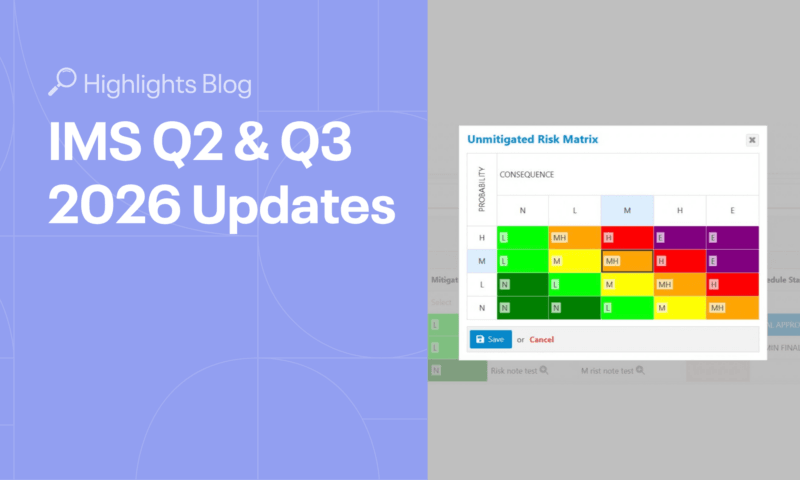
In IMS, every anomaly can be assigned two risk scores: unmitigated risk and mitigated risk. Based on those scores, IMS proposes a response – monitor, investigate, or repair – with recommendations following consistent logic regardless of who performs the assessment.
Each time an anomaly is updated, IMS records who assessed it, who reviewed it, and when those actions occurred, creating a clear audit trail for every decision.
The Anomaly Management workflow is a continuous loop rather than a straight line ending at sign-off:
- An inspection finding is recorded in IMS.
- The finding is captured and risk-assessed as an anomaly.
- If mitigation is required, it becomes an inspection schedule or corrective-action report rather than a note in an email.
- The mitigation is carried out.
- The anomaly record is updated during the next inspection, extending its history rather than starting a new record.
An anomaly remains open until it is explicitly closed. Flexible dashboards summarize anomaly status and help users identify overdue or unassessed anomalies. This prevents findings from being forgotten and temporary repairs from quietly becoming permanent.
Because every revision remains attached to the same record, an integrity engineer can see an anomaly’s complete history in one place: when it was first identified, how its risk score and recommended response changed, and who approved each assessment.
That is the difference between reacting to an individual inspection finding and managing a condition throughout the life of an asset.
Ready for a Demo?
To see how Anomaly Management could fit into your inspection workflow, request a walkthrough of IMS.

Tomislav Renić Technical Writer
Tomislav is an experienced engineer and technical communicator with over 20 years in complex systems, modeling, and project management. As a Technical Writer at Cenosco, he translates engineering concepts into clear, user-friendly documentation for software in the oil, gas, and refining industries.