In the process industry, safety is not just a requirement; it is a responsibility. Oil, gas, and chemical facilities operate in environments where high pressures, flammable substances, and complex machinery can quickly turn a minor fault into a major incident. Protecting people, the environment, and valuable assets demands more than vigilance. It requires smart, proactive safety management.
That is where Safety Instrumented Systems (SIS) play a vital role. From identifying hazards to maintaining safeguarding systems that keep plants running safely, the SIS Lifecycle is essential. However, it is often complex, fragmented, and difficult to manage.
Imagine if it did not have to be this way.
IMS SIS transforms the traditional SIS Lifecycle by bringing every stage together in one integrated digital platform. It provides a single point of entry and a single source of truth, supporting everything from hazard identification through SIS maintenance in a streamlined and reliable way.
In this article, we explore the challenges across the SIS Lifecycle and highlight the benefits of integrating the lifecycle stages and elements into a single tool.
What Is the SIS Lifecycle?
The functional safety standard IEC 61511 provides a structured framework known as the Safety Instrumented Systems (SIS) Lifecycle for managing Safety Instrumented Systems in the process industry. See a depiction of the SIS Lifecycle below.
The SIS Lifecycle outlines the stages required to identify hazards, assess associated risks, and develop protection layers to prevent or mitigate those risks. It places particular emphasis on the specification, design, testing, and maintenance of the SIS. The objective is to ensure that the SIS consistently delivers the required level of risk reduction so that overall risk remains at acceptable levels.

The SIS Lifecycle can be grouped into three main stages:
- Analysis (see the purple steps)
- Design and Implementation (see the blue steps)
- Operation and Maintenance (see the green steps)
These stages form a continuous improvement cycle, similar to the Plan, Do, Check (& Act) methodology (see image below).

SIS Lifecycle – Analysis Stage
The LOPA determines the risk gap for a set of HAZOP cause and consequence pairs by estimating the frequency of the initiating cause and evaluating the adequacy and strength of existing barriers. When a LOPA scenario shows a risk gap and a Safety Instrumented Function (SIF) is identified as a valid barrier, the risk gap defines the minimum required Risk Reduction Factor (RRF) for that SIF. This RRF can be translated into a target Probability of Failure on Demand (PFD), which determines the required Safety Integrity Level (SIL).
Once the risk gap and required RRF have been established, the SIF Analysis is performed. Its objective is to design the SIF subsystems, including equipment selection, actuator configuration, and proof test intervals, so that the achieved PFD meets or exceeds the target PFD. This must be achieved while ensuring acceptable success criteria, fault tolerance, and performance.
The final output of the Analysis stage is the Safety Requirements Specification (SRS) report.
SIS Lifecycle – Design and Implementation Stage
The input to the Design and Implementation stage is the SRS report. Throughout the SIS Lifecycle, the SRS report is a key document and often serves as a contractual agreement. The SRS report communicates the safety requirements defined during the risk assessment stages and must be clearly understood by engineers, plant operators, maintenance personnel, and application programmers.
During this stage, hardware matching takes place, including Distributed Control Systems (DCS), Interconnected Protection Systems (IPS), and related systems. Application program logic is developed, and Factory Acceptance Testing (FAT) is performed. This stage also includes the design and implementation of additional risk reduction measures such as alarms, pressure relief valves, and procedural controls.
SIS Lifecycle – Operations and Maintenance Stage
A SIF enters the Operations and Maintenance stage once a project, plant, or unit has been commissioned. Individual SIF components must be periodically proof tested to ensure they continue to deliver the required level of risk reduction throughout the mission time.
An important output of the SIF Analysis is the proof test interval. To remain compliant, proof testing must be performed according to this interval. Deviations or failures identified during testing require corrective maintenance (repairs). Over time, SIF equipment may be modified or decommissioned.
In accordance with IEC 61511 clause 16.3.1.5, testing frequency must be periodically re-evaluated. This stage therefore includes regular reviews to capture changes such as test results, failures, bypasses, overrides, and SIF demands. This data should be used to update the LOPA study and, where required, adjust the SIF design. Brownfield modifications also require a loopback to earlier lifecycle stages.
Interdependency of the SIS Lifecycle Stages
The SIS Lifecycle stages and their elements are closely interconnected. HAZOP, LOPA, SIF Analysis, the SRS report, and equipment proof test scheduling all depend on each other. Changes in one stage or element can directly impact others.
For example, adding a new cause and consequence pair in a HAZOP may change the SIL requirement in LOPA, which then requires a review of the SIF Analysis and potentially different proof test intervals.

The SIS Lifecycle Information Flow Challenge
Any project, from conception through decommissioning, produces a wide range of documents and involves multiple disciplines. When focusing specifically on the SIS Lifecycle, these documents include HAZOP study reports, LOPA study reports, SIF design verification reports, SIF proof test procedures, SIF proof test reports, and more.
Engineers from different disciplines rely on the information contained in these documents during project execution and throughout operations for their day‑to‑day activities. Because of the document interdependency, managing document revisions quickly becomes complex. As soon as changes or additions are made to the original design, earlier study documents can become outdated. Given the dynamic nature of projects and operating facilities, where design changes are common, this situation occurs frequently. As a result, disciplines may struggle not only to locate the information they need, but also to ensure they are working with the most current version.
In addition, it is necessary to track all information gathered and all changes made throughout the SIS Lifecycle in order to demonstrate SIS integrity. This is a time‑consuming task, made more challenging by the fact that information is often spread across multiple software tools and databases. This challenge applies not only to the Analysis and Design stages, but also to the Operations and Maintenance stage, where changes that may affect the SIS must be captured. Examples include proof test results, failures, and SIF demands. Tracking this data is particularly difficult when information is collected offline in the field.
An integrated solution addresses these challenges by providing a single point of entry and a single source of truth across the SIS Lifecycle.
The Benefits of a Single Source of Truth for SIS Lifecycle Management
The greatest benefit of using an integrated tool is that it enables a single point of entry and a single source of truth across the various stages of the SIS Lifecycle.
A single point of entry means that engineers from different disciplines access the same information through the same interface throughout the SIS Lifecycle. For example, this could be a single URL with secure login credentials that provides access to a site database containing master HAZOP study reports, LOPA study reports, SIF documentation, and related data.
Below are the key benefits of maintaining a single source of truth throughout the SIS Lifecycle.
Smooth Collaboration Between Discipline
Multiple engineering disciplines rely on each other’s studies and outputs. A single source of truth provides all relevant stakeholders with one central location to access the information they need, improving collaboration and reducing misalignment between teams.
Assurance that Documentation is Always up to Date
Version confusion across studies is eliminated through structured revision management and synchronization. Users can be confident that they are always working with the most current information. This is particularly important for Brownfield environments, where Management of Change (MOC) activities or small projects require controlled updates to master documentation. After completion, these changes are properly reintegrated into the master records.
Synchronization Checks when Studies are Revised
Single-source software enables synchronization between SIS Lifecycle modules such as HAZOP, LOPA, SIF Analysis, and equipment proof test scheduling. Since a change in one study can impact others, updates can be flagged automatically so affected studies are reviewed and revised as needed based on the new input data.
Compliance Demonstration
Maintaining a single source of truth across the SIS Lifecycle ensures that all study data and field information is captured, tracked, and traceable. This supports auditability, demonstrates SIS integrity, and simplifies compliance with functional safety requirements.
More Relevant Failure Rate Data
By recording proof test results, failures, and SIF demands directly within the single source, more accurate failure rate data can be derived. Asset‑specific failure rates can be compared with published datasets and used to refine or weight generic data, resulting in more realistic inputs for the asset under consideration.
Increased Work Efficiency
Work efficiency improves across several areas:
- Reduced rework and fewer errors: Improved information flow between SIS lifecycle stages and elements reduces rework, engineering effort, and the likelihood of human error. Easy access to SIS information across disciplines further increases efficiency.
- Linked and traceable recommendations: Recommendations can be created directly within the software based on study outcomes, assigned to responsible individuals, given due dates, and tracked to closure.
- Efficient proof testing and maintenance planning: Equipment proof-test scheduling can be managed from a single access point, with maintenance engineers and planners granted access. Dashboards can show which proof tests are scheduled, while proof test procedures can be accessed and completed digitally in the field, with results stored directly in the condition history.
- Lower overall costs
- Using a single integrated solution reduces the need for multiple software applications and licenses to cover the full SIS Lifecycle, thereby lowering overall costs.
IMS SIS enables all these benefits across the complete SIS Lifecycle.
How IMS SIS Supports a Single Source of Truth Accros the SIS Lifecycle
IMS SIS is an all-in-one SIS management software solution that enables users to capture, manage, and maintain all SIS Lifecycle data within a single tool.
IMS SIS includes the following key capabilities (also see image below):
- A configurable hierarchy aligned with the site’s equipment structure
- Master Equipment records containing data such as dangerous and safe failure rates, proof test coverage factors, and beta factors
- A HAZOP module to document and manage the results of HAZOP studies
- A LOPA module to document and manage the results of LOPA studies
- A SIF Analysis module to verify SIF designs against the SIL assigned during the LOPA study and to generate the Safety Requirements Specification (SRS) report
- A proof test Scheduling module to plan and manage proof tests assigned to SIF equipment
- A Condition History module to capture field proof test results and operational data for SIF equipment using configurable proof test checklists
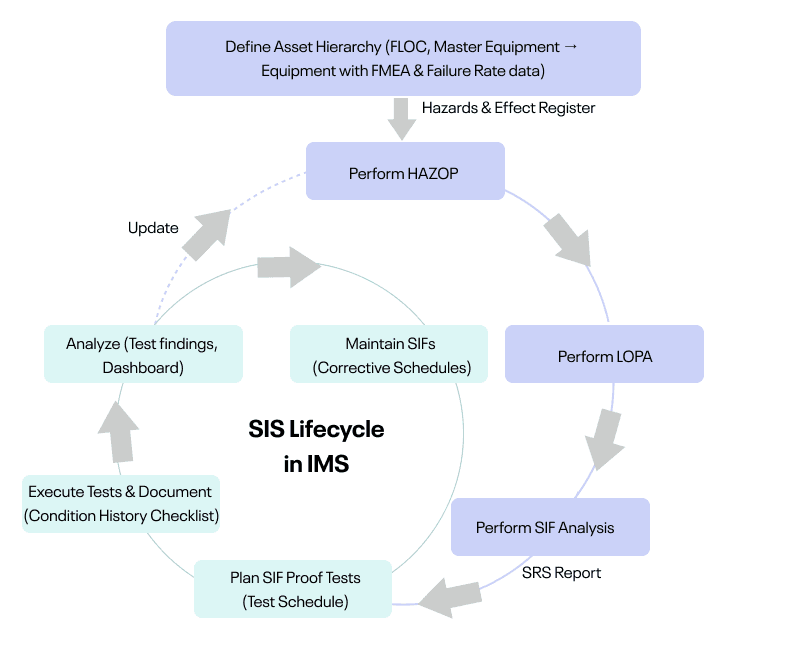
The following sections describe how IMS SIS supports the SIS Lifecycle and maintains a single source of truth. In particular, they explain how integration and synchronization between modules ensure consistent, traceable, and up‑to‑date SIS information throughout the lifecycle.
Equipment
IMS SIS supports a configurable hierarchy that reflects the applicable site equipment structure. This hierarchy can be created directly within IMS SIS. Ideally, however, IMS SIS is interfaced with a Computer Maintenance Management System (CMMS), such as SAP. In that case, the hierarchy in IMS SIS mirrors the master hierarchy maintained in the CMMS.
Each equipment record contains comprehensive information, including:
- General equipment details
- An overview of the SIF Analyses in which the equipment is used
- Assigned proof test schedules
- Credited proof tests recorded in the Condition History
- Failure Mode and Effects Analysis (FMEA) data, including proof test coverage factors, diagnostic coverage factors, and beta factors per failure mode, inherited from linked Master Equipment
- The linked Master Equipment record
- Equipment implementation details such as fault tolerance modifiers, voting logic, and repair information
- The linked hierarchy structure, including plant, site, unit, and functional location
From both SIF Analyses and HAZOP studies, users can perform advanced tag searches to quickly locate and link relevant equipment. Once linked, all associated equipment data becomes immediately available within the study. Proof test intervals calculated during the SIF Analysis are automatically synchronized back to the equipment records.
Master Equipment
IMS SIS contains a comprehensive Master Equipment library that includes dangerous and safe failure rates, proof test coverage factors, beta factors, and other reliability parameters. Individual equipment tags can be linked to these Master Equipment records. When linked, the Master Equipment data is copied to the equipment tag and used in PFD calculations and Dangerous Fault Tolerance determinations within the SIF subsystems. Equipment tags, or sections thereof, can later be unlinked and populated with user‑defined data.
If users maintain their own failure rate datasets, custom Master Equipment records can be created. Alternatively, the Master Equipment database can be prefilled with industry data from sources such as OREDA.
HAZOP Study
The SIS Lifecycle begins with the HAZOP study, which serves as the primary risk assessment. For each HAZOP node, standardized guidewords and process parameters are applied to identify deviations from design intent. For each deviation, credible causes and likely consequences are documented.
Risk analysis is then used to assess severity and determine whether existing safeguards adequately reduce risk. When risks remain unacceptable, recommendations can be created, assigned to responsible individuals, given due dates, and tracked to closure.
If additional risk reduction is required, a LOPA study can be initiated directly from the HAZOP. In this case, the LOPA is linked to the relevant HAZOP consequence, and key data is synchronized between the two studies (see image below), including:
- Causes and corresponding initiating events
- Safeguards and corresponding barriers
- Consequences and severity ratings

LOPA Study
A LOPA is a semi‑quantitative risk assessment in which initiating event frequencies and barrier PFD values are evaluated against defined tolerability criteria. Initiating event frequencies may be based on industry‑accepted datasets or site‑specific operational data. IMS SIS provides an extensive failure rate database while also allowing users to maintain their own datasets.
IMS SIS also includes a library of predefined barrier templates with associated PFD values. When a LOPA is linked to a HAZOP consequence, relevant data is synchronized between the studies.
If a LOPA scenario results in a required RRF greater than one and includes a valid SIF barrier, the resulting RRF is used as the target PFD input for the SIF Analysis. As with the HAZOP, recommendations generated during LOPA studies can be assigned and tracked. Team composition can also be defined, with the option to copy team members directly from the associated HAZOP study.
SIF Analysis
The SIF Analysis determines whether the proposed SIF hardware configuration meets both the Dangerous Fault Tolerance requirements defined by the assigned SIL and the target PFD derived from the LOPA study.
IMS SIS contains built‑in Dangerous Fault Tolerance criteria, with the option to configure additional requirements where needed. The analysis results in a calculated Achieved PFD, which is influenced by factors such as hardware architecture, failure rates, proof test intervals, and diagnostic coverage.
IMS SIS supports linking multiple LOPA scenarios to a single SIF Analysis. In such cases, the most conservative target PFD is automatically applied. Any updates to linked LOPA studies are synchronized back to the SIF Analysis.
Subsystems defined within the SIF Analysis are linked to equipment records, ensuring that all relevant reliability data is available. Calculated proof test intervals are synchronized back to the equipment records.
The final output of the SIF is the Safety Requirements Specification (SRS) report, which formally documents the design basis, performance requirements, and verification results of the SIF. Generating the SRS report automatically from a single data source improves compliance, increases efficiency, and reduces the risk of human error.
Proof Test Scheduling
IMS SIS supports equipment proof test scheduling when maintenance engineers and planners are granted access. Proof tests can be assigned to schedules and viewed through dashboards that provide visibility into upcoming activities. Test intervals are synchronized directly from the SIF Analyses.
When IMS SIS is interfaced with a CMMS such as SAP, proof test schedules can be linked to maintenance plans and work orders can be generated automatically.
Condition History
IMS SIS supports configurable checklists, also referred to as dynamic forms, for defining proof test procedures. These procedures can be reused to ensure consistency. Proof test results can be captured directly in the field using tablets, even when offline, and stored in the Condition History module via IMS4Field.
If issues are identified during proof testing, corrective actions can be created directly from the Condition History. Alternatively, inspection data collected outside IMS SIS can be imported using bulk upload functionality.
Revision Management
IMS SIS applies structured approval workflows across studies. Before approval, consistency checks ensure that all mandatory information is present. Approved studies must be returned to draft before modifications can be made. Changes in linked studies trigger out‑of‑sync warnings to maintain consistency.
Only one active, or evergreen, version of each HAZOP, LOPA, or SIF Analysis exists at any time. Previous versions are archived and remain accessible through the revision history.
Syncing Study Data
Data synchronization between modules is controlled through draft and approval states. Changes in one study trigger warnings in linked studies, prompting review and re‑synchronization as needed. HAZOP studies act as the master source for shared objects.
User Roles
IMS SIS uses role‑based access control to ensure data integrity while enabling collaboration. Users are assigned specific editing and viewing rights per module, allowing disciplines to contribute safely within defined boundaries.
SIS Database
IMS SIS includes a comprehensive configurable database that supports standardization, efficiency, and data quality. The database includes elements such as:
- Master Equipment with associated failure rate date
- Deviations and Guidewords
- A Hazard and Effect Register together with Top Events
- Function Groups
- Subsystems
- Initiating Events and associated frequencies
- Barriers and associated PFDs
- Proof Test Checklists
Editing rights are typically restricted to designated focal points.
Summary: Enabling a True Single Source of Truth Across the SIS Lifecycle
Managing the SIS Lifecycle requires coordination across disciplines, strict revision control, and traceable data. Without smart integration, complexity increases risk and inefficiency.
IMS SIS provides a single, integrated platform that ensures consistency, traceability, and confidence across all SIS Lifecycle stages and elements. By serving as a smart single source of truth, IMS SIS helps organizations manage functional safety more effectively and sustainably.
Learn more about IMS SIS
If you want to join other industry leaders using IMS SIS for their full SIS Lifecycle processes, fill out the form below to get started with a demo.

Elsa Tolsma-de Klerk Technical Writer
Elsa is an engineer with a passion for sharing knowledge. She holds a Master’s in Electronic Engineering and spent over a decade at Sasol as an Advanced Process Control Engineer, where she gained hands-on experience in optimization, control systems, and writing technical documentation. Since 2019, she’s been a Technical Writer at Cenosco, now leading the IMS knowledge base and training Academy team.